X
CLient Portal


.svg.webp)

If the second quarter was about relief, the third was about endurance. A supply shock in oil, a sharp repricing of interest rates and a wobble in the AI trade all landed in the same three months, and yet U.S. shares still finished higher. The S&P 500 gained 2.03% for the quarter while the Dow fell 1.9% and the Nasdaq rose 2.2% (CNBC). The headline numbers were calm. The path to get there was not.
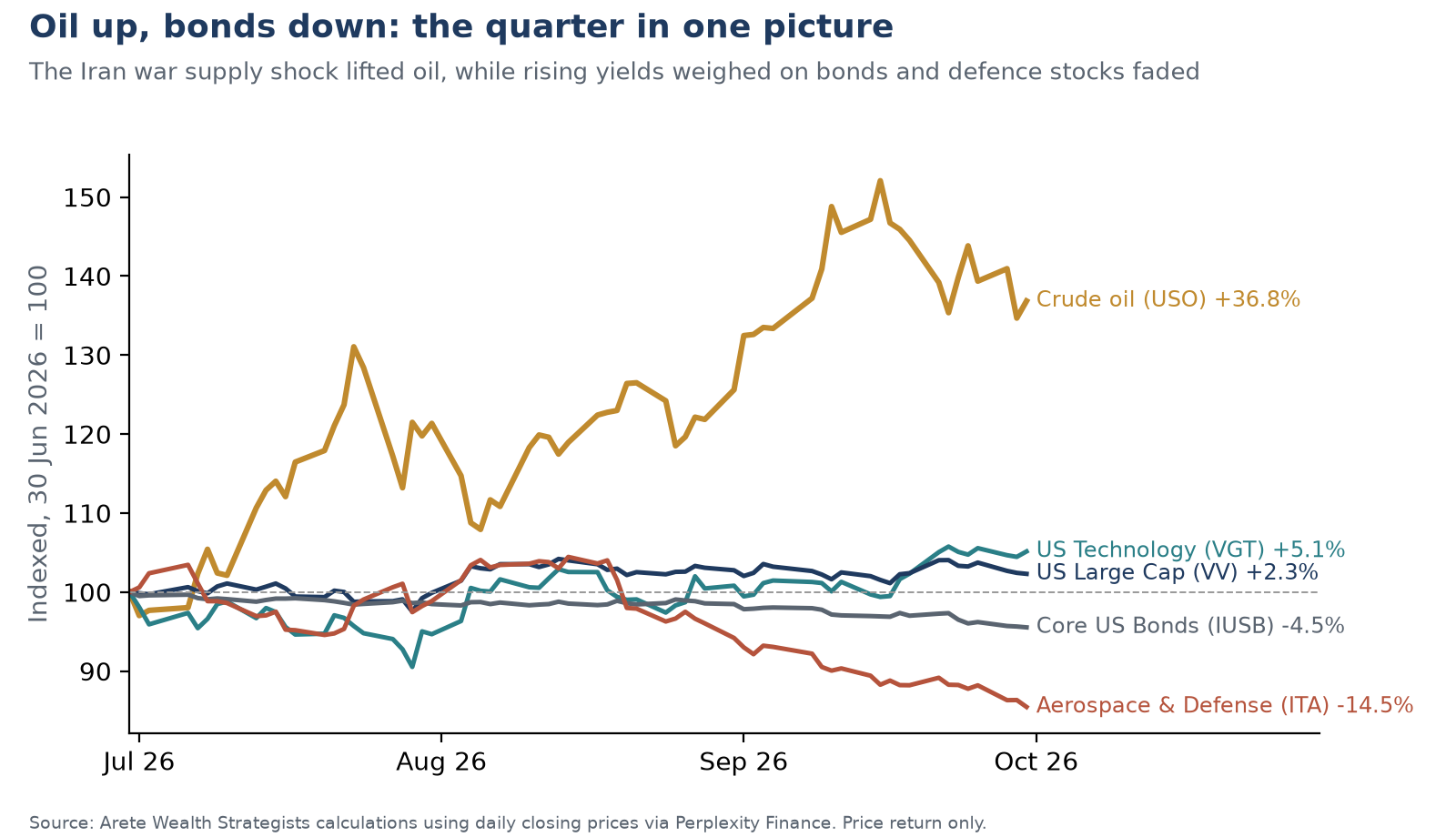
The Iran conflict set the tone for the quarter. With the Strait of Hormuz still blocked and no diplomatic breakthrough, Brent crude rose 42% to US$103.53 a barrel, its third-largest quarterly gain in a decade (CNBC). Higher energy costs, new tariffs and AI-related capital spending kept inflation pressures elevated.
Central banks responded. The Federal Reserve, under new Chair Kevin Warsh, raised rates by 0.25% to 3.75%–4.00% in September, its first increase in three years. Sixteen of 18 policymakers expect at least one more hike in 2026, and the Fed now does not see inflation back at 2% until 2029 (Reuters). In Australia, the RBA lifted the cash rate to 4.60%, its fourth increase of 2026 and the highest level in 15 years (ABC News). Across developed markets, more than 80% of central banks raised rates during the quarter (J.P. Morgan Asset Management).
There was still good news underneath. September business surveys in the U.S. reached their highest level since mid-2021, and the labour market improved (J.P. Morgan Asset Management). Second-quarter corporate earnings grew 53.7% (Reuters). In short, the economy is running hot rather than running out of steam, which helps profits but keeps pressure on interest rates.
Bonds had the hardest time. The U.S. 10-year Treasury yield rose more than 0.85% over the quarter, one of its largest quarterly rises in 50 years. U.S. investment-grade and high-yield corporate bonds had their worst quarter since 2022 (Reuters). The 10-year finished September at 5.29% (FRED).
In our models, core, corporate and mortgage bond funds fell about 4.5%–5.3% in price, while hedged international bonds held up better. Income of roughly 1% for the quarter offset part of that fall. Bond losses are never welcome, but starting yields above 5% mean new money is now being reinvested at the best rates in almost two decades. Academic research also reminds us that when inflation drives markets, shares and bonds tend to move together (Campbell, Pflueger & Viceira). That is why we hold gold and market-neutral strategies alongside bonds, rather than relying on duration alone.
Share market leadership narrowed again. Large U.S. technology and AI businesses led, while semiconductors fell more than 11% as investors moved from chipmakers toward software and hyperscalers (CNBC). Goldman Sachs described market breadth as the narrowest since 2000 (Reuters).
Rising rates hurt smaller companies, which carry more floating-rate debt. The Russell 2000 fell more than 6% and lagged the S&P 500 by over 9 percentage points (CNBC). Emerging markets dipped about 1% after a strong first half, with Korea falling almost 20% (CNBC). Defence stocks, which had led the market earlier in the year, gave back gains as talk of a negotiated peace and a possible reopening of Hormuz grew (Yahoo Finance). The ASX 200 ended the quarter flat (CNBC).
Our May rebalance helped in several places. We added to U.S. large caps, cut emerging markets (for example, from 6.0% to 4.5% in the ETF 60/40 model), and in the Hybrid models raised alternatives from 1% to 4% through a market-neutral fund. Our technology sleeve and 1% gold position both added value.
Two positions held us back. Our small-cap weighting, which we had increased, fell with the broader small-cap market. Our aerospace and defence sleeve (2%–4% depending on the model) was the weakest holding, down about 14.5%. Bonds dragged on the more conservative models, broadly in line with benchmarks. Our BlackRock Aladdin risk analysis estimates a 60/40 portfolio falls about 4% for every 1% rise in the 10-year yield. That is only slightly above the benchmark, so we did not take a large bet on rates.
We remain pro-risk but selective. We’re overweight U.S. and emerging market shares, underweight long-dated Treasuries, and prefer short- and medium-term bonds and agency mortgages (BlackRock Investment Institute). It also argues that markets may be overstating how far the Fed will go (BlackRock).
In our forthcoming Q4 model update, we’ve kept equity at 1% overweight. We’ve shifted AI exposure from the companies building the technology toward those adopting it, reduced regional tilts and momentum exposure, kept duration slightly underweight, and added to core and global government bonds. Lead portfolio manager The right approach is to stay invested while trimming positions that have become riskier than intended. With that in mind, we will review these changes at our next rebalance, with particular attention to our small-cap and defence sleeves.
The fourth quarter brings U.S. midterm elections, further central bank decisions and, we hope, progress toward ending the conflict in the Middle East. Higher yields are uncomfortable in the short term, but they rebuild the income that makes balanced portfolios work. We remain diversified, disciplined and focused on what we can control. As always, please reach out if you would like to discuss your portfolio.
Charts: Arete Wealth Strategists, using daily closing prices via Perplexity Finance (price return, 30 June to 30 September 2026; excludes distributions). Past performance is not a reliable indicator of future results. This commentary is general information only and does not take into account your personal objectives, financial situation or needs.

Access our comprehensive, unbiased financial guides here.
.webp)
.webp)

.webp)
.webp)
.png)
.png)
.png)




%20(1).webp)
.webp)

.webp)