X
CLient Portal


.svg.webp)

When headlines announce that Australia has been named in the latest round of US tariff proposals, the natural instinct is to imagine broad, immediate damage to Australian trade, the dollar, and share prices. The evidence suggests a more nuanced picture.
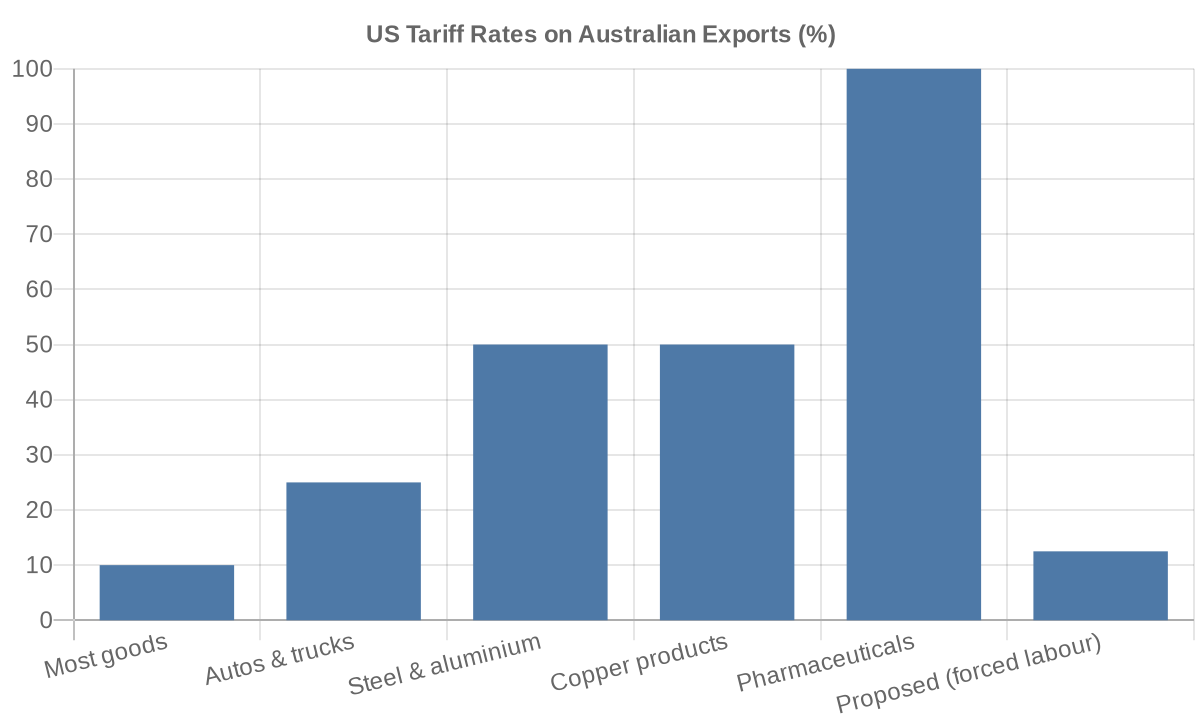
Current US tariff rates by category on Australian exports; forced-labour rate is proposed only. Source: DFAT, Easyship, ABC News.
Here is what is actually in place. Since April 2025, a 10% baseline surcharge has applied to most Australian goods entering the US. On top of that, steel, aluminium and copper products face rates ranging from 10% to 50%, autos and trucks are taxed at 25%, and certain pharmaceuticals now carry a 100% tariff. A newer proposal, still working through public comment and hearings scheduled from early July 2026, would lift the rate on some Australian goods from 10% to 12.5% under a forced-labour enforcement framework covering roughly 60 economies. That proposal is not yet law.
The forced labour tariff proposal sits on top of this picture rather than reshaping it entirely. In its Section 301 investigation, the Trump administration has alleged that Australia – along with roughly 60 other economies – is not doing enough to prevent goods made with forced labour overseas from entering its market and, by extension, global supply chains that compete with U.S. producers. The proposed 12.5 per cent rate is framed as an enforcement tool to push Australia toward tighter import screening and supply‑chain due diligence, rather than a response to systemic forced labour occurring inside Australia itself. Canberra has pushed back on that characterisation, stressing that Australia already has robust modern slavery legislation and a growing regime of reporting and compliance obligations, and warning that unilateral U.S. tariffs risk being more about domestic U.S. politics than effective human‑rights enforcement. At this stage, the “forced labour” tariff remains a proposal working its way through hearings and comment, and Australian officials and industry groups are lobbying hard to narrow its scope or avoid implementation altogether.
So what does all this mean in practice? The US absorbs only about 4–6% of Australia's total exports and represents somewhere between 0.8% and 1.5% of GDP, according to figures from both the Reserve Bank of Australia and Ai Group. The RBA's own assessment is that higher US tariffs are likely to have only a small direct effect on Australian export volumes overall. Treasury modeling cited by Ai Group puts the drag at roughly 0.1% of GDP in 2025 and 0.2% in 2026. The pain is real, but it is concentrated: advanced manufacturing, aircraft parts, medical instruments, certain metals, and parts of the pharmaceuticals sector are the most exposed. Gold and many critical minerals remain exempt from the baseline tariff, which matters considerably given that Australian gold exports to the US ran to about A$4.6 billion in a single month.
Of course, the Australian dollar has weakened, falling roughly 3.4% against the US dollar over the past month, and the ASX sold off almost 3% around the initial tariff announcement, compared with a 5% drop in the US market. But economists and official agencies consistently point to the indirect channel as the more consequential risk: slower global growth and softer Chinese demand for Australian commodities, not the bilateral tariff rate itself.
History offers a useful frame here. During the 2018–19 US-China trade conflict, commodity prices and global risk sentiment moved Australian markets far more than any direct measure aimed at Australian exports. The current episode appears to be following a similar pattern.
Access our comprehensive, unbiased financial guides here.
.webp)
.webp)

.webp)
.webp)
.png)
.png)
.png)


.png)


%20(1).webp)
.webp)

.webp)