X
CLient Portal


.svg.webp)

What is the U.S. tariff rate these days? If you're tempted to answer with one number, you're in good company, but the question no longer has a one-number answer. Effective July 24, 2026, new Section 301 duties (a provision of trade law aimed at practices the U.S. government deems unfair) cover 60 trading partners, which account for about 99.4% of U.S. imports. According to Morgan Lewis, the added rates generally run from 10% to 12.5%, subject to product and country exemptions.
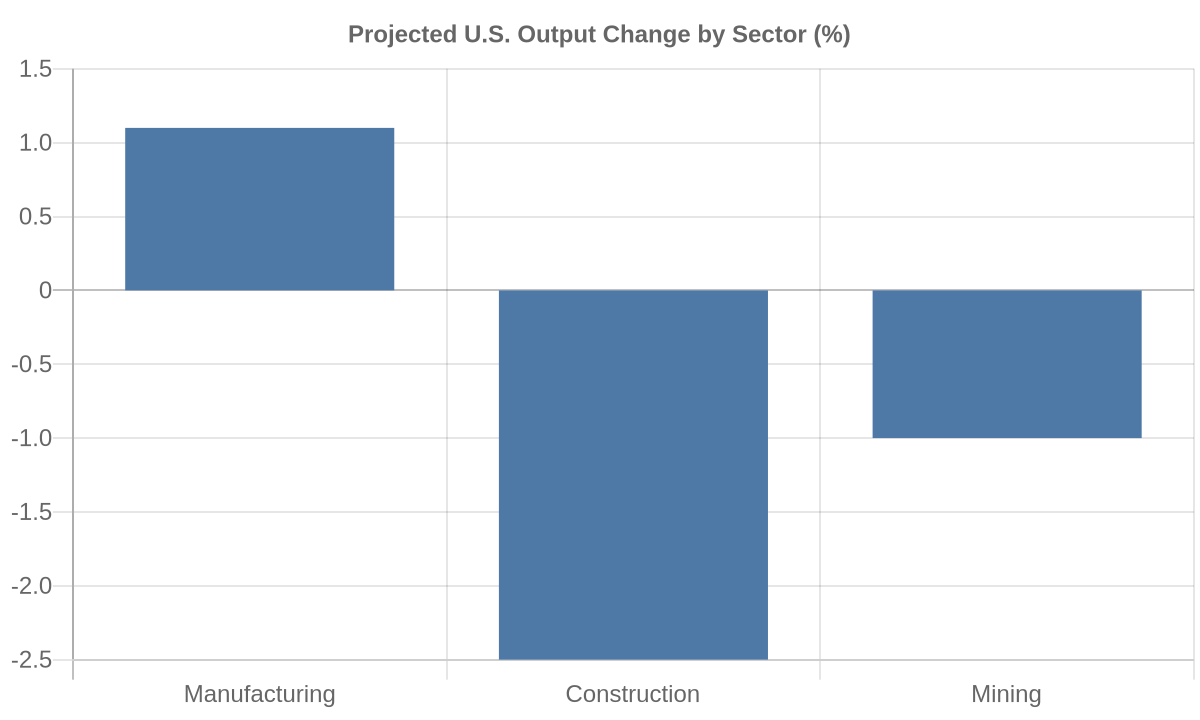
Modeled projections of sector output change under 2026 tariffs; The Budget Lab at Yale, April 8, 2026.
Where does the variation come from? Start with geography. A 10% rate generally applies to partners such as Canada, Mexico, India, and the United Kingdom, while most goods from other investigated economies face 12.5%. For the European Union and Taiwan, the combined total of the ordinary most-favored-nation rate (the standard tariff most trading partners pay) and the new duty generally cannot exceed 10%. And goods already covered by separate Section 232 measures, such as steel, aluminum, autos, auto parts, and copper, are generally excluded from the new duties altogether.
Those separate measures follow their own logic. Since April 6, derivative products with high steel, aluminum, or copper content face 50%, most other derivatives face 25% on their full import value, and some face a 15% minimum, while products under 15% metal by weight fall outside the metal-content treatment (though other duties may apply), according to The Budget Lab at Yale. Patented pharmaceuticals get a third approach: a 100% tariff effective September 29, 2026, with generic and orphan drugs exempt and lower or zero rates available to companies with onshoring and pricing agreements. Three measures, three dates, three rulebooks.
Interestingly, some rules reward rearranging the supply chain itself. Officials directed tariff-rate quotas (a set volume of imports that enters on better terms, with the usual duty applying beyond it) for certain textile and apparel imports from Bangladesh, Cambodia, Indonesia, and Malaysia, with qualifying volumes entering without the new duty when importers use U.S. textile inputs. Implementation was described as feasible by September 1, 2026, but the quantities await a separate Federal Register notice, so the size of that opening is unknown.
So what does all this add up to? Allianz Research estimated the average U.S. tariff at 12.4% once the temporary Section 122 tariff expires, up from a projected 7.7% in May. That is an effective average (what remains after weighting for exemptions, product mix, and trade agreements), not a rate anyone pays on a given shipment. The Budget Lab's modeling, in turn, points to a price level 0.5% to 0.7% higher (about $760 to $940 per average household), which describes a step up in costs rather than a permanently faster inflation rate.
The practical takeaway is to stop asking for the tariff rate and start asking which rate applies to a specific product, from a specific country, under a specific authority. The answer depends on the fine print: the product's classification, its metal content, its origin, and whether a company has an agreement or a quota in place. Headlines will keep offering one number; importers will need many.
Access our comprehensive, unbiased financial guides here.
.webp)
.webp)

.webp)
%20(1).webp)
.webp)

.webp)